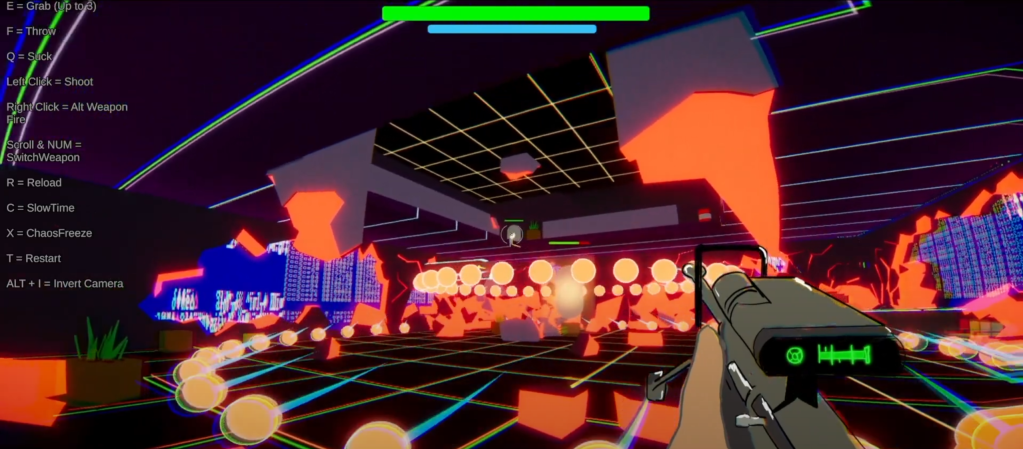
Purging a broken system through physics, precision, and playful chaos
Overview
Cybercleanse is a first-person action project developed in Unity that blends fast gunplay, physics-led puzzle solving, and systemic map destruction. The game takes place inside a collapsing operating system where you play as EXE-01, an antivirus program fighting evolving malware. The core loop asks you to survive bullet hell encounters, use debris to charge a combat meter, spend that meter on reloading and powers, and reach extraction points.
The project investigates how readable feedback, modular enemy design, and a tightly integrated toolset can produce high agency play without clutter. It draws inspiration from Superhot for cause-and-effect timing, Control for telekinetic play, DOOM Eternal for rhythmic combat pacing, Teardown for destruction-driven problem solving, Scarlet Nexus for psychokinetic flair, and the neon grammar of Tron.
Design Philosophy
The design prioritises clarity of consequence. Every system is built to communicate what happened, why it happened, and what might happen next. Abilities and weapons are not siloed. They are designed to chain, collide, and cascade so the best solutions feel discovered rather than prescribed. Enemy behaviours follow clean rules that can be learned under pressure, and the environment responds to force in ways that are consistent and legible.
Two principles shaped day-to-day decisions. First, readable combat. Trails on enemy bullets, simple silhouettes, and consistent telegraphs keep encounters learnable even as difficulty rises. If an object looks liftable, it should be. If a surface looks hard, projectiles should ricochet. This keeps puzzles and firefights drawing from the same vocabulary.
Key Gameplay Features
Telekinesis at the centre
Lift and hold up to three objects, then throw them with true mass and momentum. Use debris as cover, damage, bridges, or keys that wedge open doors.
Gravitational control
Black Hole pulls in debris and incoming bullets, clearing space and recharging ammo. Chaos Freeze randomises force vectors in a radius, scattering hazards and opening chance-based lines.
Weapons with intent
A machine pistol with an underslung micro-grenade handles pressure and crowd control. A ricochet gun rewards geometry awareness, and some enemies can only be hurt by shots that strike from a reflected angle.
3D bullet hell
Projectiles form modular patterns in three dimensions. Pattern sets escalate based on enemy health and time in encounter. Trails aid orientation so you can thread gaps and plan routes.
Destruction as design
Walls fracture, chunks carry mass, and explosives reshape sightlines. Puzzles frequently ask for multi-system solutions, for example pinning a weakened wall with an anchor point, then detonating TNT while redirecting debris with telekinesis.
Readable interface
A minimal diagnostic HUD shows health integrity, ability cooldowns, meter charge, and node markers. Terminals deliver short logs that expand the fiction without breaking momentum.
Technical Highlights
Built in Unity URP, the project uses Shader Graph for glitch and outline effects, TextMeshPro for crisp UI, and FMOD for responsive audio. Gameplay modules follow single-responsibility classes, with abilities authored as ScriptableObjects for quick iteration. Enemies combine finite state machines for reliable state control with behaviour trees for context, producing states for idle, player detected, four distinct attack patterns, and player lost, which returns to idle after a two-second delay.
Physics run through PhysX with interpolation on grabbable bodies. Mesh fracture, chunk mass assignment, and collision layers keep destruction believable and performant. Object pooling limits allocation churn for debris and bullets. LODs and frustum culling maintain frame pacing in busy scenes.
Development Process
Months before the main push, a small 2D bullet hell prototype was built to prove modular patterns and timing. That prototype was later rebuilt in 3D, adding depth-aware trajectories and spatial telegraphs, then integrated into the main project. When the 3D segment moved across, player bullets were mistakenly firing the enemy detection zone. The enemy controller was adjusted so that detection operated independently of player projectiles, which stabilised behaviour across encounters.
Enemy projectiles were tuned to interact with destructible walls. Early shots sometimes ghosted through geometry or over-triggered fractures. Colliders, layers, and impact forces were adjusted until bullets contributed to wall health loss in a predictable way. Parallel work focused on the glue between systems. Telekinesis, ricochets, grenades, explosives, and Black Hole now share consistent physics so a solution discovered in a puzzle space also applies in combat.
Enemies
Viruses are modular and readably themed around malware behaviour such as spreaders, replicators, and possessors. Some wear frontal plating that rejects direct hits, encouraging flanks and banked shots. Bullet patterns escalate by phase and can combine radial sprays, chasing spirals, and gated volleys. Telegraphs include short visual glitches and audio pips before large volleys, while colour and trail weight denote danger.
Art Direction
The style favours bold shapes and high contrast over surface noise. Clean zones use cool palettes and tight grid geometry. Corrupted zones warm up, distort, and bloom with chromatic drift and particle glitches. Outline shaders keep targets readable against busy scenes. Skybox, lighting passes, and a restrained VFX library keep focus on interaction.
Project Management
Work was tracked in Trello using lists that mirror the codebase and scene work, for example Character and Control Systems, Player Abilities and Interaction, Weapon Systems, Destructible and Environmental Mechanics, Level Design and Blockouts, Enemy Systems and AI, Visuals and Shaders, and UI and HUD. Cards were drawn directly from GitHub commits so code reality and planning stayed aligned. Sprints set modest, verifiable goals such as converting the 2D patterns to 3D, stabilising enemy detection, or bringing wall health and fracture into line with projectile forces.
Quality Assurance and Playtesting
Internal test passes focused on clarity and cohesion. Bullet trails were adjusted until they gave direction without clutter. Enemy state transitions were verified under stress, moving from idle to detection to one of four attack patterns, then to player lost and back to idle after the two-second grace period. Combined-load tests ran physics, AI, destruction, grenades, ricochets, and Black Hole at once. Where sequences fell out of sync, timings and layers were corrected. The result is a suite of encounters that remain readable under pressure and a sandbox that holds together when players push it.
What We Learned
Readable systems make difficulty fair. A ricochet puzzle and a ricochet kill share the same rules, which helps players transfer knowledge across contexts. Investing in shared physics paid dividends. Telekinesis and destruction feel like two faces of the same tool rather than separate features. Building the bullet hell in 2D first saved time by letting pattern logic mature before the cost of 3D space and camera.
 Saif Ahmed
Leave a comment